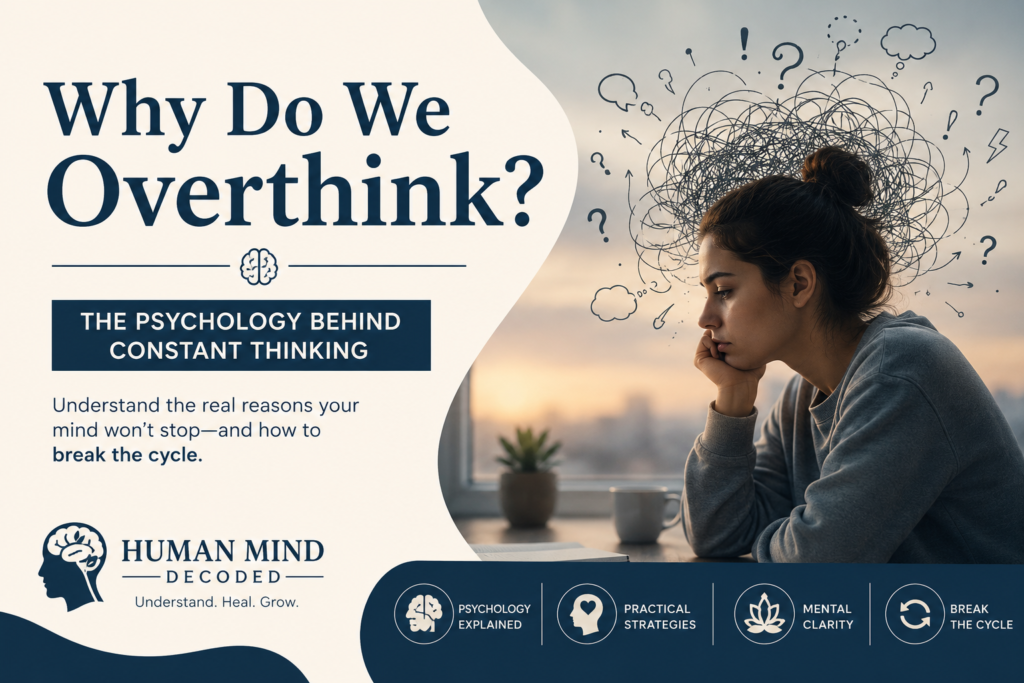
Have you ever replayed the same conversation in your head over and over again? Or spent hours worrying about something that hasn’t even happened yet? If yes, you’re not alone. Overthinking is one of the most common mental habits, and while it may seem like problem-solving, it often creates more stress than solutions. In this article, we’ll explore why our brains overthink, what psychology says about it, and how to break the cycle.
What Is Overthinking?
Overthinking is the habit of repeatedly analyzing situations, conversations, or decisions long after they have happened- or before they even occur. Instead of helping us solve problems, excessive thinking often traps us in a cycle of worry, self- doubt, and mental exhaustion. Psychologists describe overthinking as a pattern of repetitive thoughts that can increase stress and make it harder to take action.
7 Psychology- Backed Reasons Why We Overthink
Overthinking doesn’t happen without a reason. It is often driven by the brain’s attempt to protect us from uncertainty, failure or emotional pain. Here are seven common psychological reasons why people overthink.
1 . Your Brain Is Trying To Protect You
From an evolutionary perspective, the human mind is designed to detect threats before they happen. Thousands of years ago, anticipating danger helped our ancestors survive. Today, the same survival system often treats everyday situation- like an important interview, a difficult conversation, or making a life decision-as potential threats.
When your brain senses uncertainty, it starts generating “what if” scenarios. It believes that thinking through every possible outcome will keep you safe. Unfortunately, instead of finding solutions, you end up trapped in endless mental loops. The brain mistakes excessive thinking for preparation, even when it only increases anxiety.
2. Fear Of Making Wrong Decisions
Many people overthink because they believe there is only one perfect decision. Whether choosing a career, ending a relationship, or buying something expensive, the fear of making a mistake can become overwhelming.
Psychologists call this analysis paralysis. Instead of acting, people continue collecting information, comparing options, and imagining every possible consequence. Ironically, delaying the decision often creates more stress than making an imperfect choice.
3. Perfectionism Creates Endless Thinking
Perfectionists often believe that every decision, project, or conversation must be flawless. This unrealistic standard pushes the brain to review every detail repeatedly.
Instead of feeling satisfied, perfectionists constantly search for mistakes they may have missed. This habit fuels overthinking because nothing ever feels “good enough.” Learning to accept progress instead of perfection can significantly reduce mental exhaustion.
4. Negative Past Experiences Train Your Brain To Expect The Worst
If you’ve experienced failure, rejection, betrayal, or embarrassment in the past, your brain naturally tries to prevent those painful experiences from happening again. As a result, it becomes extra cautious and starts analyzing every situation for possible risks.
While this protective response is normal, it can become excessive. Instead of learning from the past and moving forward, your mind keeps replaying old memories and comparing them to present situations. This often leads to unnecessary worry and keeps you stuck in a cycle of overthinking.
5. Anxiety Makes Smaller Problems Feel Bigger
Anxiety and overthinking often reinforce each other. When you’re anxious, your brain becomes more alert to potential dangers, even when there is no immediate threat. Small uncertainties begin to feel like major problems.
Rather than focusing on facts, the mind creates worst-case scenarios and treats them as if they are likely to happen. This constant mental activity drains your energy, increases stress, and makes it difficult to relax or enjoy the present moment.
6. Low-Self Confidence Increases Self-Doubt
People with low self-confidence often question their own decisions, abilities, and opinions. They may replay conversations, second-guess simple choices, or constantly wonder whether they said or did the right thing.
This habit of self-doubt feeds overthinking because every decision feels uncertain. Building confidence doesn’t mean never making mistakes—it means trusting yourself to handle whatever happens, even if things don’t go exactly as planned.
7. Modern Life Overloads Your Mind
We live in a world filled with constant notifications, endless information, social media comparisons, and unlimited choices. While technology offers convenience, it also gives our brains more information to process than ever before.
The more options and information we have, the harder it becomes to make decisions. This mental overload contributes to overthinking, making it difficult to focus on what truly matters. Taking regular breaks from digital distractions can help your mind become calmer and more focused.
How To Stop Overthinking
The good news is that overthinking is a habit, and like any habit, it can be changed with consistent practice. While you may not be able to stop unwanted thoughts completely, you can learn to respond to them in healthier ways. Here are some practical strategies that psychologists often recommend.
1. Practice Noticing Your Thoughts Instead of Fighting Them
The first step to reducing overthinking is becoming aware of when it starts. Instead of trying to force your thoughts to stop, simply notice them without judging yourself. Ask, “Is this thought helping me solve a problem, or am I just going in circles?” This small shift creates distance between you and your thoughts, making them easier to manage.
2. Focus On What You Can Control
Overthinking usually revolves around things we cannot fully control—the future, other people’s opinions, or outcomes. Redirect your attention to the actions you can take today. Even one small step forward is more helpful than hours of worrying about possibilities.
3. Set A Time Limit For Decisions
Give yourself a reasonable deadline for making decisions. For example, if you need to choose between two options, decide that you’ll make your choice within 30 minutes or by the end of the day. Time limits prevent endless analysis and build confidence in your decision-making abilities.
4. Write Down Your Thoughts
Journaling helps move thoughts out of your head and onto paper. When you write your worries down, they often become clearer and less overwhelming. Many people discover that the problems they imagined are not as serious as they first seemed.
5. Practice Mindfulness
Mindfulness means paying attention to the present moment instead of constantly living in the past or future. Simple practices like focusing on your breathing, taking a walk without your phone, or observing your surroundings for a few minutes can help calm an overactive mind.
Final Thoughts
Overthinking is something almost everyone experiences at some point in life. While it may feel like your mind is trying to protect you, excessive thinking often creates more stress than solutions. The good news is that overthinking is a habit—not a personality trait—and habits can be changed with practice.
By understanding why your brain overthinks and applying simple strategies like mindfulness, journaling, and focusing on what you can control, you can gradually break the cycle. Progress won’t happen overnight, but every small step helps you build a calmer, more confident mind.
Frequently Asked Questions (FAQ)
Is Overthinking a Mental illness?
No. Overthinking itself is not a mental illness. However, it can be a symptom of conditions such as anxiety or depression. If overthinking significantly affects your daily life, speaking with a mental health professional can be helpful.
Can Overthinking be Stopped Completely?
Everyone overthinks occasionally. The goal is not to eliminate all unwanted thoughts but to prevent them from controlling your life. With consistent practice, you can greatly reduce the frequency and intensity of overthinking.
Why Do I Overthink at Night?
Many people notice overthinking becomes worse at night because there are fewer distractions. A quiet environment allows unresolved worries and thoughts to surface more easily.